Revision built on the exam's own blueprint.
Every session is weighted to your exam's blueprint and tilted toward your weakest subject. Anything you miss is scheduled to come back before you forget it, and every answer names the source it rests on.
5 questions a day free — no card needed
Also on Android: Google Play
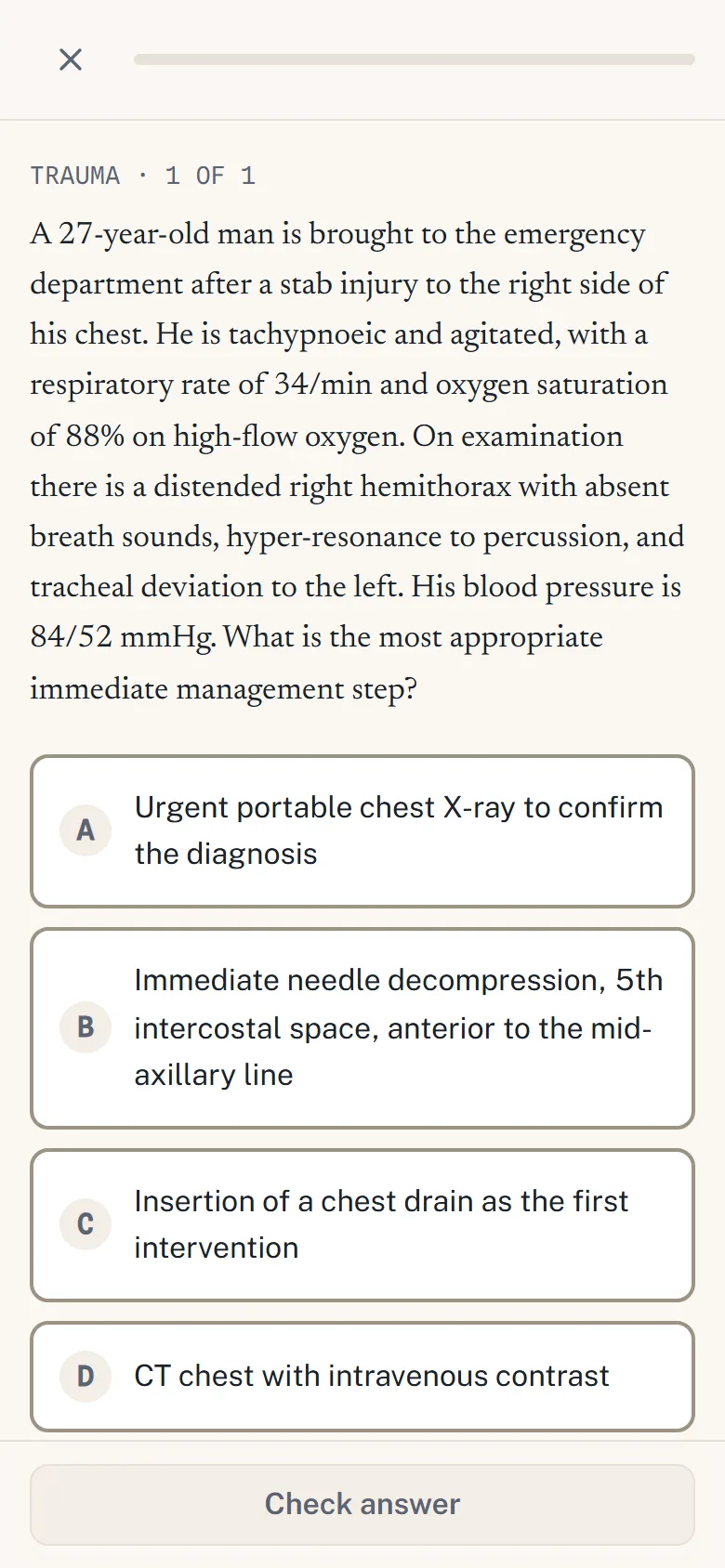
A 27-year-old man is brought to the emergency department after a stab injury to the right side of his chest. He is tachypnoeic and agitated, with a respiratory rate of 34/min and oxygen saturation of 88% on high-flow oxygen. On examination there is a distended right hemithorax with absent breath sounds, hyper-resonance to percussion, and tracheal deviation to the left. His blood pressure is 84/52 mmHg. What is the most appropriate immediate management step?
- Source
- Advanced Trauma Life Support (ATLS) Student Course Manual, 11th Edition (American College of Surgeons Committee on Trauma, 2025) — Thoracic trauma: recognising and decompressing a tension pneumothorax
- Checked
- Read against this source on 12 Aug 2026. If the guidance changes, the question comes back for another read before it is shown again.
Where this answer comes from
TAKEAWAY
Tension pneumothorax is a clinical diagnosis treated on the spot, not imaged first. Current ATLS teaching places emergency needle decompression in the 5th intercostal space, anterior to the mid-axillary line — the chest wall there is thinner than at the older 2nd intercostal, midclavicular site, which failed more often in obese or muscular patients.
Why B is right
This is the current ATLS standard site and technique for emergency decompression of a tension pneumothorax, ahead of formal chest drain insertion.
Tension pneumothorax is a clinical diagnosis. Waiting for imaging in a haemodynamically unstable patient with these findings delays a life-saving intervention that should happen at the bedside.
A formal chest drain follows decompression rather than replacing it — it takes longer to place and the patient needs the pressure released now. It is the correct next step, not the first one.
CT has no role in an unstable trauma patient with a clinical tension pneumothorax; it delays treatment for a diagnosis that examination has already made.
The findings — hyper-resonance, absent breath sounds and tracheal deviation — point to the pleural space, not cardiac tamponade, which instead presents with muffled heart sounds and a raised JVP (Beck's triad).
You just answered one. Five a day are free.
Start freeA real question, written in-house to this exam's style, shown exactly as it would play in the app.
How SpecialityMCQs works
Revision fails on the boring stuff: what you practise, and whether you meet it again before it fades.
- Weighted like the blueprint
- Misses come back
- Aimed at your weak subjects
Every answer names the source it rests on, and the date that source was last read. See how a day works.
New questions are published every week, each checked against a named source.
"The deck decides what you see tomorrow."
That is the whole method, in one line: the exam's blueprint sets the mix, your own misses set the order.
How it works
Passing is not a leap. It is a curve.
-
Answer
5 new questions a day, free, weighted to your exam's blueprint and tilted toward your weakest subject.
-
Review
Anything you miss joins your review deck, scheduled to come back until it sticks. Reviews stay free forever.
-
Track
Practice readiness bands by subject. Paid plans add 28-day accuracy trends across your subjects.
What it looks like
The screens behind the three steps
Built for the long revision months
Spaced repetition that will not let go
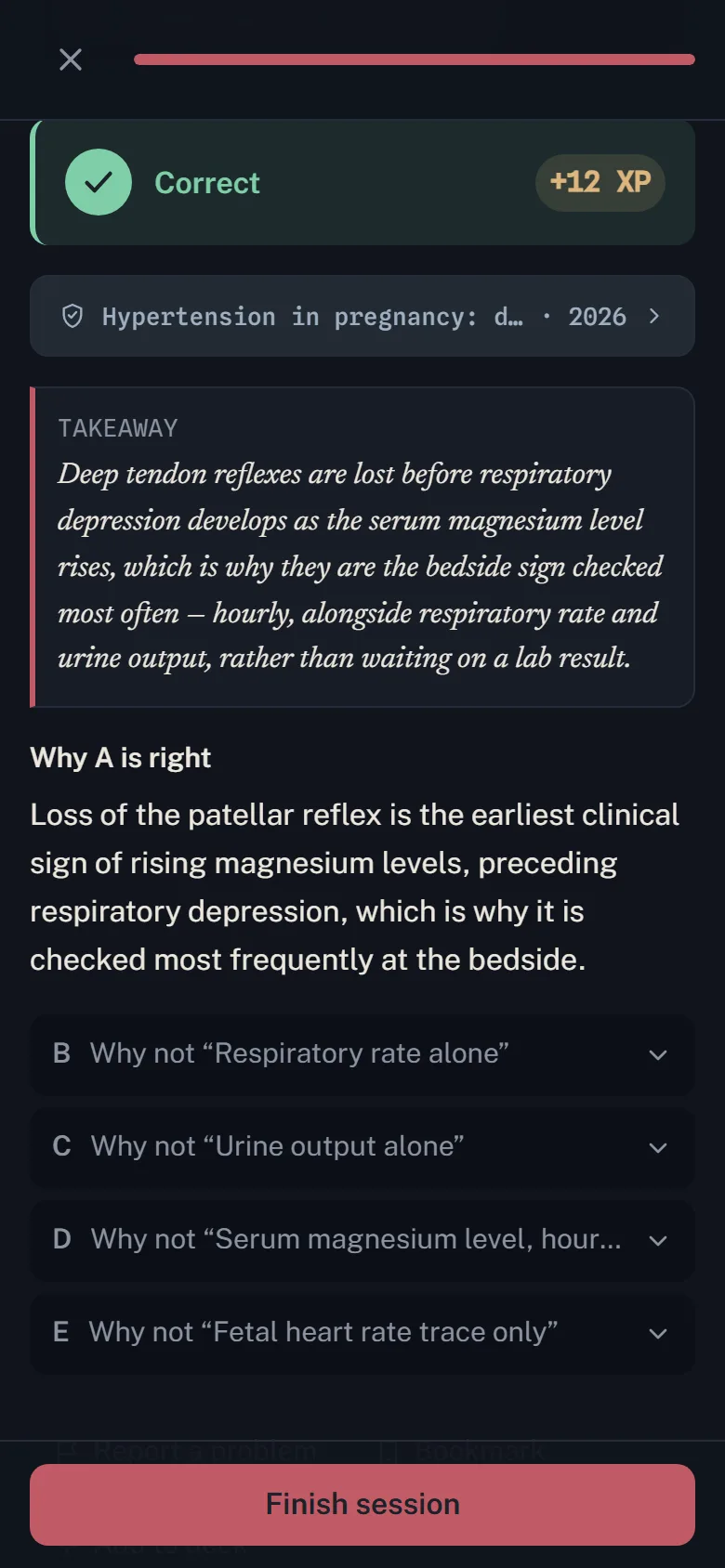
Miss a question and it joins your review deck, scheduled so it comes back until it sticks. Reviews are free forever.
Practice readiness by subject
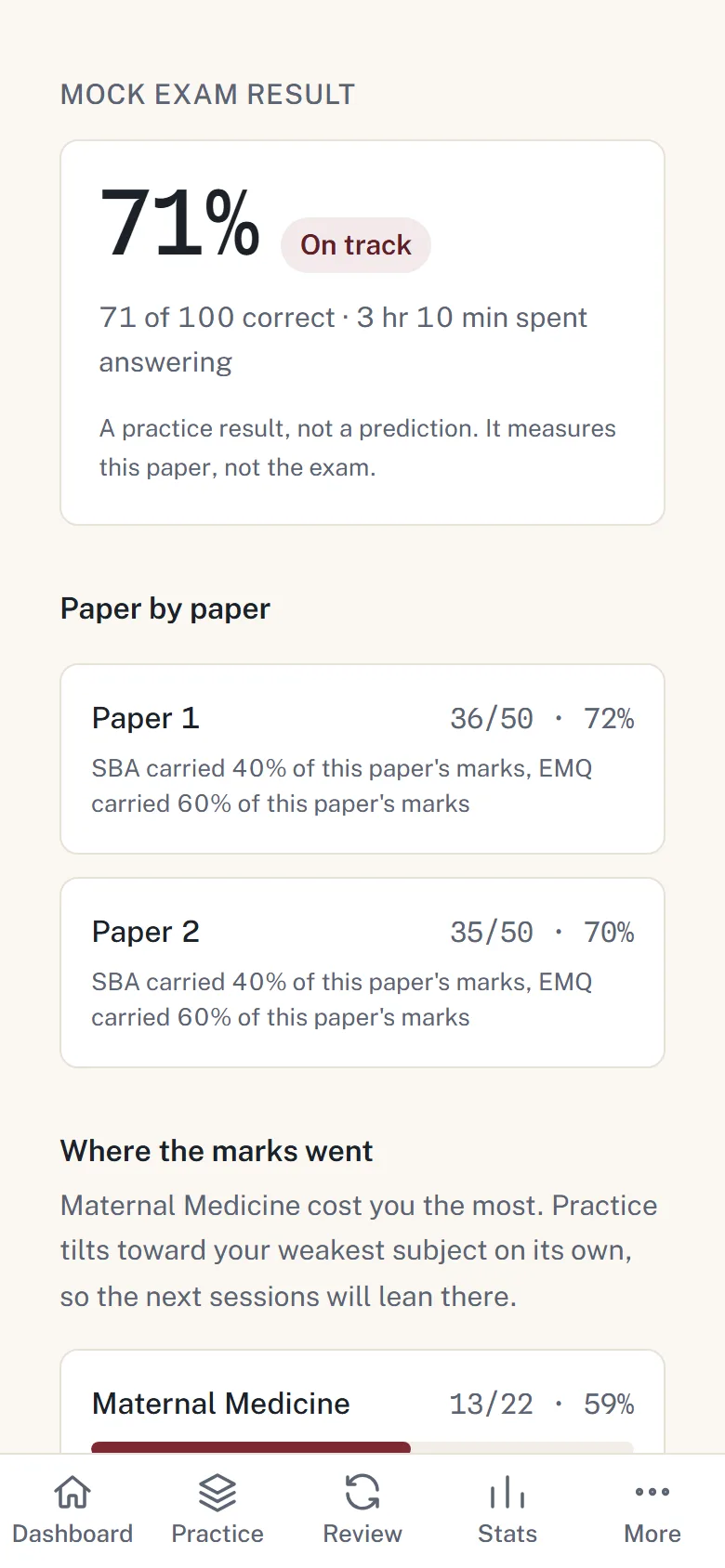
Track your practice readiness by subject. These bands describe practice performance, not your probability of passing.
References as a feature, not a footnote
Every answer names the guideline or textbook it rests on and the date that source was last read, set out in full underneath the explanation, not hidden in a tooltip.
EMQ practice that plays like the exam
Extended matching questions keep their themed option list beside the stem, exactly as they sit in MRCOG, MRCPsych and other EMQ papers — never simplified into single-best-answer.
Accuracy trends Paid
28-day accuracy trends across your subjects, so you can see where you are gaining and where to push.
Seven exams, one method
MRCS, MRCOG, MRCPCH, MRCPsych, MRCEM, FRCR 2A and the MSRA each run on the same review deck, weighted to that exam's own blueprint.
Who this is for
Registrars, and the trainees behind them
Core trainees sitting a Part A for the first time, ST3 candidates returning after a failed attempt, doctors preparing between on-calls with no fixed study block. Different routes, the same exam, and the same problem: too little time, and no clear sense of where it should go. That is the part SpecialityMCQs decides for you.
Sitting a specific exam? Read the guide for MRCS , MRCOG , MRCPCH , MRCPsych , MRCEM , FRCR 2A or MSRA .
Seven exams, one method
Pick your exam
Every family below runs the same review deck, weighted to that exam's own blueprint. Open one for the format, the blueprint chart, and a sample question styled exactly like the app player.
-
MRCS
2 papersMRCS Part A
Applied basic sciences and the principles of surgery in general, tested as single best answer.
Exam guide & sample question →
-
MRCOG
4 papersMRCOG Part 1 and Part 2
Part 1 basic science, Part 2 clinical management — single best answer, and extended matching from Part 2 onward.
Exam guide & sample question →
-
MRCPCH
2 papersMRCPCH Foundation of Practice and Theory and Science
Two theory papers, both 100 single best answer, one clinical (FOP) and one scientific (TAS).
Exam guide & sample question →
-
MRCPsych
2 papersMRCPsych Paper A and Paper B
Paper A leans basic science and psychopharmacology; Paper B leans clinical psychiatry and critical review.
Exam guide & sample question →
-
MRCEM
3 papersMRCEM Primary and MRCEM SBA
Primary is basic science in a clinical shell; SBA tests emergency decision-making against the RCEM curriculum's own outcomes.
Exam guide & sample question →
-
FRCR 2A
2 papersFinal FRCR Part A (Clinical Radiology)
Two three-hour single-best-answer papers, text only with no images, testing the reasoning behind the report across all eleven areas of the clinical radiology curriculum.
Exam guide & sample question →
-
MSRA
2 papersMulti-Specialty Recruitment Assessment (MSRA)
NHS England's specialty recruitment assessment rather than a college exam: one foundation-level clinical paper and one professional dilemmas paper, sat back to back.
Exam guide & sample question →
Pricing
Full pricing detailLaunch code LAUNCH19, entered at checkout on this website: a first 4 months at £19 instead of £29, and a first 8 months at £39 instead of £49. New accounts only, one use each; the plan then renews at the usual price until you cancel.
Free
£0
forever
5 new questions a day · review deck, streaks and quests free forever · no card needed
Start freeBoth paid plans cover every exam family. There is no per-exam pricing.
Free tier: 5 new questions a day. The review deck, streaks and quests are free forever.
Renews automatically, cancel any time
Questions candidates actually ask
Full FAQHow does SpecialityMCQs decide what to show me?
Two things drive it. A session is built to your exam's blueprint, so the balance of subjects matches the paper rather than your comfort zone.
On top of that, a per-subject rating moves as you answer, and the session tilts toward whichever subject is currently costing you marks. Anything you get wrong is scheduled to come back on a spacing curve, so you meet it again shortly before you would have forgotten it.
I only get twenty minutes between clinics. Is that enough?
That is the size the product is built around. 5 new questions plus whatever your review deck owes you is a normal day, and the deck is what makes short days add up rather than evaporate.
Which exams does SpecialityMCQs cover?
MRCS Part A, MRCOG Part 1 and Part 2, MRCPCH Foundation of Practice and Theory and Science, MRCPsych Paper A and Paper B, MRCEM Primary and MRCEM SBA, Final FRCR Part A (Clinical Radiology), Multi-Specialty Recruitment Assessment (MSRA). Each runs on the same review deck, weighted to that exam's own blueprint.
Is there a SpecialityMCQs app?
Yes — on Android, and in any browser. It is one account across all of them, so a session you start on the ward carries on at home, and the daily free questions work the same way everywhere.
Is SpecialityMCQs free?
You get 5 new questions a day free, and the review deck, streaks and quests are free forever. Paid plans remove the daily cap and add your accuracy trends.
How are EMQ questions handled?
The themed option list sits beside the stem on desktop, or above it in a collapsible sheet on mobile, and never reflows between stems that share a theme — the same layout you meet in the exam.
Is SpecialityMCQs affiliated with any of the royal colleges, or with NHS England?
No. SpecialityMCQs is an independent revision tool and is not affiliated with, or endorsed by, any of the royal colleges, NHS England, or any other exam authority named on this site.
Where do the explanations come from?
Every published question names the guideline or reference its answer rests on, and the date that source was last read, so you can go and read it yourself rather than take our word for it. More on how the content is written and checked is in the full FAQ.
Can I cancel?
Any time, from Settings via the billing portal. Access continues to the end of the period you paid for.
Start with free questions today
Weighted to your blueprint, aimed at your weak spots, and yours to keep coming back to. The review deck is free forever.
Start freeNo card needed. Cancel anything, any time.